




Growing together: Integrating farmers into value chains with sustainable finance

Growing together: Integrating farmers into value chains with sustainable finance

From March 24 to 31, 2026, a series of meetings on sustainable agriculture development and carbon sequestration were held in Osh, Bishkek, and Manas town in Jalal-Abad region.

The events were organized within the framework of the “Value Chain Agro Finance” project and brought together representatives of government institutions, local authorities, farmers, partner organizations, and experts from the agricultural sector.

During the meetings, participants discussed resource-efficient and regenerative agricultural practices, as well as their role in enhancing the sustainability of agricultural production. Particular attention was given to no-till farming technology as a key approach for preserving soil moisture, increasing productivity, and restoring soil fertility.


In addition, participants explored opportunities for carbon sequestration in agriculture and the potential for carbon credit certification. These mechanisms could provide farmers in Kyrgyzstan with access to climate finance and create additional income streams in the future.

The meetings served as an important platform for knowledge exchange and coordination among stakeholders, contributing to the development of a shared vision for sustainable growth in the country’s agricultural sector.

As a part of the implementation measures to provide technical support and increase the capacity of State laboratories, in March 2026 the Value Chain Agro Finance Project organized a study tour to Germany for laboratories personnel. During the study tour the participants visited key technical centers in the laboratory industry and biotechnology in Germany and the European Union.

The key event was participation in the international Analytica 2026 exhibition in Munich. As the world’s leading platform for laboratory technology, the exhibition showcased to the participants the main automation trends and the latest technological advancements. The study tour program also included a visit to Shimadzu Europa Gmbh, the global leader in manufacturing of laboratory analytical equipment.


The study tour allowed the laboratory personnel to deepen their knowledge and contributes to the achievement of goals in strengthening  the technical capacity of laboratories in modernizing the quality control and research system for food products and implementation of innovative research methods.

The participants had a unique opportunity to get acknowledged with the innovative tech developments, take part in practical demonstrations, establish professional network with equipment suppliers and enrich their knowledge related to current European methods on modern approaches to ensuring food safety.


On March 6 and 10, 2026, field based training sessions were conducted for farmers in Sokuluk and Moscow districts within the framework of the Value Chain Agro Finance project focusing on grain production.

The trainings were organized with the participation of the public association AgroLid and aimed at improving farmers’ knowledge of modern agricultural technologies, efficient use of fertilizers, and crop protection practices.

In Sokuluk district, the trainings covered the villages of Zhany Zher, Zhany Pakhta, Uchhoz, Stepnoy and Kamyshanovka, with 28 participants attending. In Moscow district, the sessions were held in Belovodskoe, Spartak and Alga, with 17 farmers taking part.

Expert Estebes Beishev provided detailed guidance on spring fertilization of winter wheat, including timing and methods of nitrogen application, types of fertilizers, and recommended application rates depending on soil nutrient content.

Special attention was given to weed control under NO TILL technology. Participants learned how to assess weed infestation, select appropriate herbicides, and apply them effectively in terms of timing and dosage.

During the trainings, farmers received practical recommendations on calculating fertilizer application rates based on soil conditions, climate factors, and crop requirements. Key wheat diseases, pests, and weeds affecting productivity were also discussed along with effective control measures.

Participants were additionally introduced to the advantages of NO TILL technology, including moisture conservation, reduced soil erosion, and improved soil structure. It was emphasized that adopting this approach can help reduce production costs and increase the sustainability of agricultural practices.

The trainings were conducted in an interactive format, allowing farmers to ask questions, share experiences, and receive practical advice from experts. This approach supports the adoption of modern farming methods and contributes to increased grain productivity.


The Value Chain Agro Finance project continues conducting practical trainings in 2026 at the Center for Veterinary Diagnostics and Expertise and the Department of Disease Prevention and State Sanitary and Epidemiological Supervision.

From February 9 to 20, 2026, another series of practical sessions was held aimed at expanding the accreditation scope of these laboratories. These activities are intended to improve the quality and safety of food products.


During the practical trainings, laboratory specialists gained new knowledge on detecting antibiotic residues in food products and raw materials.

The Value Chain Agro Finance project hopes that the results of this meticulous work will be available to stakeholders in the third and fourth quarters of 2026.


From December 8 to 13, 2025, a practical training course was held at the laboratory of the Center for Veterinary Diagnostics and Expertise within the framework of the Value Chain Agro Finance project.

The training aimed to support the implementation and expansion of the laboratory’s scope of accreditation as well as to strengthen practical skills in determining residual quantities of veterinary medicinal products in food of animal origin.

During this period, the main focus was on the preparation and proper documentation of validation materials based on previously conducted practical trainings. This work represents an important step toward improving the quality of laboratory testing and ensuring compliance with international standards.

Begimay Imbraimakunova, Leading Specialist, noted: “This practical course helped us gain a deeper understanding of validation documentation requirements and systematize our existing knowledge. It directly contributes to the laboratory’s readiness to expand its scope of accreditation.”

Elzat Shambetova, Physicist Engineer, added: “Throughout the course, we thoroughly reviewed the materials from previous trainings and prepared the documentation in line with established requirements. This training format allows us to effectively apply all stages of validation in our daily laboratory work.”


From October 19 to 25, 2025, GOPA AFC GmbH, within the framework of the “Value Chain Agro Finance” project aimed at increasing agricultural productivity, improving product quality, and promoting sustainable production practices, organized a study tour to Latvia.

The event took place at the Institute of Food Safety, Animal Health and Environment “BIOR” — the National Reference Laboratory of Latvia, recognized as a leading center of expertise in analytical research and risk assessment.

The training was attended by representatives of government laboratories of the Kyrgyz Republic, including:

  • the Center for Veterinary Diagnostics and Expertise,

  • the Bishkek Center for Testing, Certification, and Metrology, and

  • the Department of Disease Prevention and State Sanitary and Epidemiological Supervision.


The program focused on enhancing the professional qualifications of specialists and familiarizing them with the practical application of analytical methods for detecting contaminants and residues, as well as with food certification procedures in accordance with European Union requirements.

Over the course of five days, participants completed an intensive training program led by BIOR’s leading experts — Prof. Aivars Bērziņš, Prof. Vadims Bartkevičs, and laboratory specialists Iveta Pugajeva, Anna Skrastiņa, Romans Pavļenko, and others.

The training covered the following key topics:

  • current EU practices in the analysis of pesticides, mycotoxins, and veterinary drugs;

  • methods of quality control and validation of laboratory analyses;

  • procedures for food certification and food supplement labeling assessment in accordance with Regulation (EU) No 1169/2011;

  • the latest BIOR research on honey quality and authenticity assessment.

Particular attention was given to traceability, food safety, and EU standards, which are key focus areas for Kyrgyz laboratories within the process of integration into international quality control systems.

The organization of such study programs contributes to strengthening the capacity of national laboratories, fostering professional networking, and promoting knowledge exchange with leading European research institutions.


From June 30 to July 4, 2025, the Laboratory of Chemical and Analytical Research of the Center for Laboratory Testing of the Department of Disease Prevention and State Sanitary and Epidemiological Supervision successfully underwent a re-accreditation procedure with an expanded scope of accreditation in accordance with the requirements of the international standard ISO 17025.

The Value Chain Agro Finance project is pleased to note that, as part of this procedure, the laboratory’s methods for food product testing were evaluated, aimed at improving the quality and safety of food products in the Kyrgyz Republic.


Key methods supported and introduced with the assistance of the project include:

  • Determination of sorbic and benzoic acids in food products;
  • Determination of sucrose, glucose, and fructose in honey;
  • Determination of lead, molybdenum, antimony, calcium, sodium, magnesium, aluminum, copper, mercury, barium, arsenic, cadmium, selenium, silver, zinc, iron, cobalt, lithium, manganese, nickel, strontium, boron, and uranium in water;
  • Determination of pesticides (simazine, atrazine, and 2,4-dichlorophenoxyacetic acid) in water;
  • Determination of synthetic dyes in soft drinks;
  • Determination of mycotoxins in food products using HPLC-MS/MS.

The Value Chain Agro Finance project expresses its sincere gratitude to all employees of the Laboratory of Chemical and Analytical Research of the Center for Laboratory Testing for their high professionalism and significant contribution to the development and improvement of the laboratory’s capabilities.


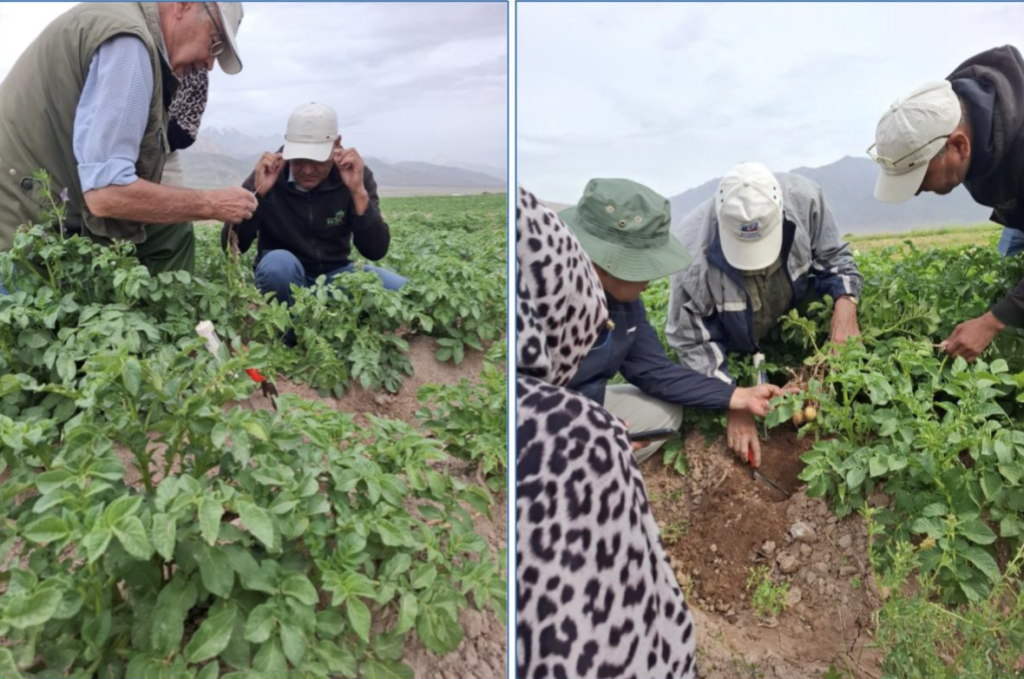
On July 13–14, 2025, a training on seed potatoes was held in the Chon-Alay district. The event was organized as part of the visit of international expert Simon Jan Schutter to Kyrgyzstan. The training was conducted under the Demonstration Cooperation Center (DCC) scheme focused on seed potatoes.

The training gathered 10 participants — farmers, project specialists, and representatives of cooperatives growing elite seed potato varieties.

On July 13, Simon Jan Schutter conducted a theoretical session, providing practical recommendations on storage, harvesting, sorting, pest protection, and disease prevention. Participants had the opportunity to ask questions related to their farms and receive useful answers.


On July 14, the training continued with a field monitoring visit to plots growing super-super elite and elite seed potato varieties. The expert, together with farmers and project specialists, inspected the fields and gave tailored agronomic advice to each farm.

Within this visit, farmers, agronomists, and inspectors received valuable knowledge and international experience on key requirements for growing seed potatoes. The materials and recommendations provided by the expert will be widely used by agronomists in further consultations and field monitoring.


From June 2 to 4, 2025, a Field Day was held as part of the ongoing project promoting soil-conserving and resource-efficient farming practices. The event took place on a farm plot in Karool village, Uzgen district, and on the Zhivprom site in the town of Kerben, Aksy district. The main goal was to promote no-till farming technology among local farmers and to showcase real examples in the field.

The project team arrived in advance to prepare the event site and set up three demonstration stations:

  1. Agrotechnology and Benefits of No-Till Farming – presented by project agronomist-consultant Atabai Toychu uulu.
  2. Plant Protection from Pests and Diseases – explained by project coordinator Bakyt Tajibaev.
  3. Economic Analysis – led by agronomist-consultant Gulmayra Mamanova, who compared traditional wheat cultivation methods with modern no-till approaches and their financial advantages.

A total of 58 participants attended the event, including farmers, local government representatives, the District Agricultural Development Office, and tractor operators from MTS.


  • From Uzgen district: 23 participants (1 woman, 2 youth)
  • From Aksy district: 35 participants (3 women, 2 youth)

Participants were registered and provided with handouts before visiting the stations in small groups. The event began with a welcome speech from the project coordinator, who expressed gratitude for the participants’ interest and outlined the project’s goals and expected outcomes.

The Field Day concluded with a Q&A session where farmers actively engaged with the presenters. The event marked an important step toward building a sustainable model for cereal production on rainfed lands.


From May 5 to 6, 2025, key events were held in Chon-Alay district, Osh region, under the Value Chain Agro Finance project:

  1. Visit of an international seed potato expert

  2. Training session for farmers

  3. Demonstration planting of Super-super elite category seed potatoes

On May 5, Simon Schutter, an expert from the Netherlands, visited the district. A meeting took place with the district administration to discuss current and planned project activities. The administration expressed readiness to fully support the initiative.

The project team and the expert then visited a local potato storage facility. Simon Schutter inspected the storage, evaluated the condition of the elite seeds, and provided recommendations to improve storage conditions.

On the same day, a theoretical training was conducted for farmers on planting technology and virus prevention during seed storage. Participants actively engaged and noted the practical value of the information received.

On May 6, a demonstration planting of the “Colombo” variety (Super-super elite category) took place on the field of local farmer Aftandil Abraimov. The expert monitored the planting process and advised participants on the technology.

After the demonstration, a discussion was held with farmers and cooperative members, where the expert shared recommendations for growing elite seed potatoes in the mountainous conditions of the region.

📌 For the first time in Kyrgyzstan, a demonstration planting of Super-super elite category seed potatoes was carried out. This important event marks a significant step forward in the development of local seed production and can serve as a model for other regions in Central Asia.