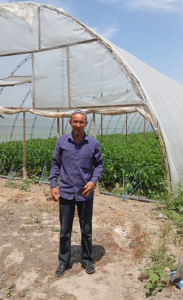
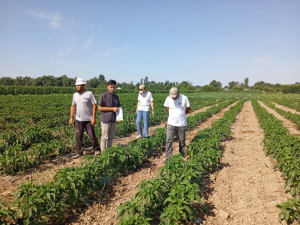
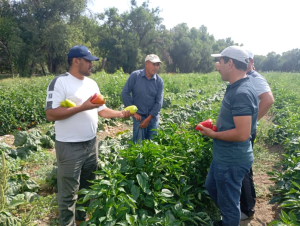
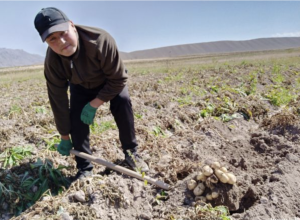
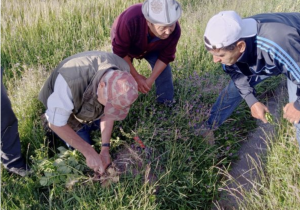
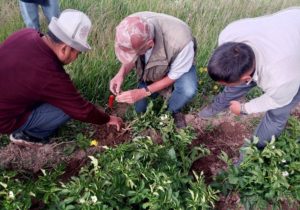
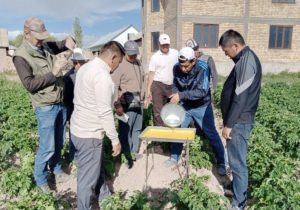
Altynbek Aibashov, a young entrepreneur from Acha-Kayindy village in the At-Bashy district, is engaged in farming. For several years, he has been growing potatoes and selling seeds. Today, he cultivates high-yield Dutch potato varieties and has mastered drip irrigation techniques. He shared insights about his agricultural business in an engaging interview with us.

Mr. Altynbek, hello! Could you introduce yourself and your business to our readers?
Hello! I was born in 1982 in Acha-Kayindy village, At-Bashy district, Naryn region. After finishing school in my village, I became a member of a farming cooperative. I studied “Traffic Management and Safety” remotely at Naryn State University, but I never worked in that field. Having spent a lot of time in agriculture, I developed a strong interest in farming. I was also elected as a village council deputy three times.
For about 20 years, we have been engaged in growing grain crops and potatoes in our village. In 2023, we established the “Kurmanbek Ata” agricultural cooperative. Our team consists of eight members, and I serve as its head.
We officially registered as a cooperative, and today, our government is paying great attention to supporting cooperatives and farming enterprises. Initially, we only had small land plots for cultivation, but last year, we received 25 hectares of land from the At-Bashy Development Fund’s department. This has allowed us to expand our business.
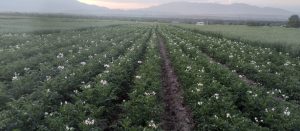
Previously, we only grew the “Picasso” variety of potatoes, but we had been thinking about planting and cultivating new varieties. Last year, that goal was realized. In Kyrgyzstan, there is a large organization in the field of agriculture called “AgroLid,” which collaborates with many companies in the seed sales sector.
This organization traveled to the Netherlands, made agreements with local farmers, and suggested that we try producing new varieties of potatoes in Kyrgyzstan. If they grow well, we could continue working together. The financial aspect was supported by the ” Value Chain Agro Finance ” project.
In the Netherlands, potatoes cost 80 soms, but once they reach here, the price would double to 160 soms. As part of the experiment, two districts in Kyrgyzstan – At-Bashy and Chon-Alai – were selected for the project.
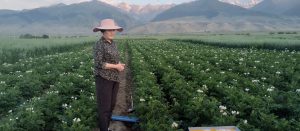
The Chon-Alai district, like At-Bashy, is a cold, mountainous region. However, unlike in Chui, we don’t face as many diseases or pest problems. We also don’t use many fertilizers for cultivation. As a result, the potatoes grown in our region are ecologically clean.
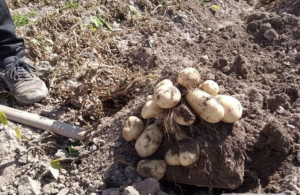
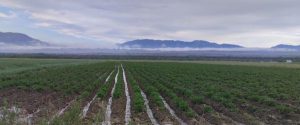
The new varieties of potatoes arrived in 25 kg bags, each with all the necessary certifications, labels, and names of the potatoes written on them. To test how Dutch potatoes would grow in our conditions, we planted potatoes of the “Super Elite” class. The results were good last year. From every hectare of our 20 sotok (0.2 hectares), we harvested 40 tons of potatoes.
Our main goal is to move from quantity to quality. Until now, we have only used “Picasso” seeds, but now we’ve received four new varieties from the Netherlands: “Silvano,” “Camelia,” “Colombo,” and “Perdis.”
-How did you master the cultivation of these new potato varieties?
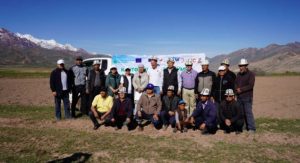
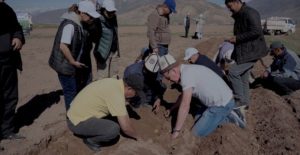
Dutch specialists came and conducted five training sessions. The ” Value Chain Agro Finance ” project covered their travel expenses. We also had local and international experts visiting us, as growing the “Super Elite” variety is quite challenging.
In the Netherlands, it takes about 10 years and 3 million euros to develop a single potato variety. It’s not an easy task. That’s why specialized experts came to train us, demonstrating the proper irrigation techniques and guiding us on how to maintain the plants during their blooming phase. They provided us with comprehensive instructions.

These lessons were a great motivation for us. Our interest in potato cultivation has increased even more. Now, people are also eager to plant these varieties.
Previously, we just planted the potatoes, watered them, hilled them, and expected to harvest the crop. But we’ve realized that there are diseases and other factors to consider. It turns out that potatoes need to be carefully tended to, like a young child, at the right time.
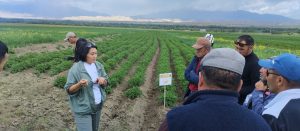
In At-Bashy, the concept of drip irrigation was not common before. To grow these new varieties of potatoes, we also mastered the drip irrigation method.
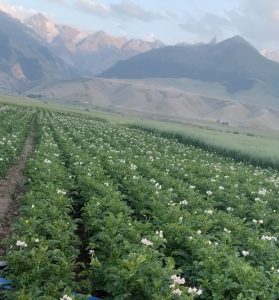
This irrigation technique is really beneficial for farming. It has provided excellent results with the new potatoes we planted. The “Super Elite” variety is showing its elite qualities. Even though it was planted in a new region, the yield has been good. The potatoes themselves also turn out to be beautiful.
-How did you master the drip irrigation method, and what are its benefits?
In the Netherlands, potatoes are irrigated using this method. We also decided to adopt drip irrigation to meet the Dutch standards, and with the recommendation of the “AgroLid” organization, we learned this technique.
In farming, water scarcity is a problem, and this method helps conserve water. With drip irrigation, only the roots of the potatoes receive water, and weeds do not absorb it. It also retains moisture better, making it easier to irrigate.
When irrigating the fields, our land is not as flat as in Chui—some parts are higher, and others lower. However, with drip irrigation, the water is evenly distributed regardless of the terrain’s slopes.
On the other hand, water in the reservoir stays warm. When water is drawn from the ditch, cold water enters the potatoes, causing them to wilt and experience stress. However, when warm water is used, the potatoes find it more comfortable.
Many farmers apply fertilizers by spreading them on the surface of the plants. This method is ineffective and allows weeds to overtake the crops. But if we apply fertilizers such as pest control solutions or organic humus through drip irrigation, mixing them with water, the nutrients directly reach the roots, making it much more beneficial.
With conventional farming methods, we could harvest 20 tons of crop, but using drip irrigation, we can achieve 40 tons. The difference is very noticeable.
Currently, many people are interested in this system. Gradually, it seems all farmers will switch to it. At the moment, many farmers in the Chui and Issyk-Kul regions have already adopted this system. God willing, this year, we plan to irrigate 6-7 hectares of land using drip irrigation.
-Where do you sell your products?
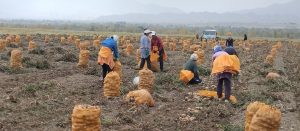
As mentioned earlier, we used to sell seed potatoes of the “Picasso” variety within Kyrgyzstan. The Dungans used to buy our seed potatoes.
The At-Bashy region is suitable for potato farming and livestock breeding. However, fruits like apples and apricots do not ripen well here. Therefore, potatoes have been widely grown in our area. But in recent years, due to the low prices of potatoes, about 50% of the people who used to plant potatoes stopped doing so. The reason is the low demand for potatoes, their cheap prices, and the financial losses people faced.
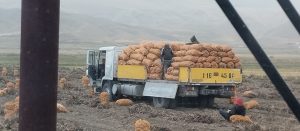
For these reasons, we have started introducing new varieties, planting them, and renewing our seed stock to attract more interest from people. The main goal is to meet the Dutch standards so that our potatoes can be bought at a good price, and we can sell them to Central Asia and Europe.
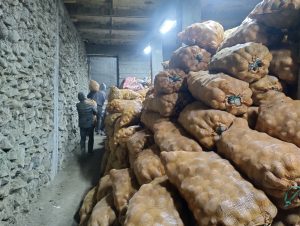
To take advantage of this opportunity, we currently need a logistics center and storage facilities for the potatoes. To build such a storage facility, it would take at least 50 million som.
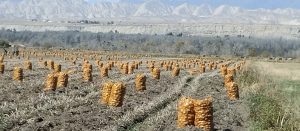
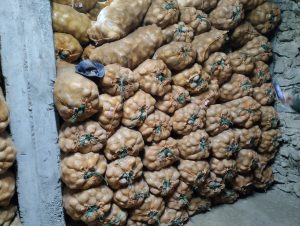
Currently, we have a 150-ton storage facility, but it is not enough, and we urgently need to construct a larger one. Last year, we harvested 45 tons per hectare, and this year, if all goes well, we will start harvesting up to 1000 tons. Therefore, we are trying to obtain concessional loans or grants to build the storage facility. Without proper logistics, it will be difficult to move forward, and we risk not being able to store the potatoes we have produced. It would be great if there were grant support for private entrepreneurs. As for the necessary equipment for potato farming, we already have everything we need.
-Have you considered exporting your products?
A few years ago, there was a demand to export 2,000 tons of seed potatoes from Kyrgyzstan to Uzbekistan. However, intermediaries ended up sending poor-quality, rotten potatoes, and when the Uzbeks tried planting them in the spring, the yield was poor. As a result, Kyrgyz potatoes were blacklisted, and they couldn’t be exported for several years.
Last year, due to global drought and a shortage of potatoes, the opportunity to export to Uzbekistan opened up again, and only then did the potato prices rise. Before that, prices were as low as 5-10 soms, and there was hardly any market demand.
-What will be the price of the new seed potatoes you are currently producing?
Currently, middlemen are selling them to people for 160 soms. However, since we are a seed and farming business, our goal this year is to offer the potatoes at a lower price of 100 soms to make it more accessible for people. God willing, we plan to start selling them at the beginning of April.

-What advice would you give to readers who want to start a business in this field?
Right now, there is a high demand for potatoes. Many people are asking about the new varieties, how they grow, and which one is suitable for them.
As mentioned earlier, we introduced four new varieties, and all of them gave good results. We can continue growing all of them in our conditions.
Farmers should choose the right land for planting. It’s important to focus on quality land and give special attention to the seed. When planting potatoes, it’s essential to treat the land in time. Many people plant potatoes thinking that if the price is high, it’s profitable, but regardless of the price, focusing on quality and consulting with farmers or agronomists for advice can lead to better yields.

-What are your future plans?
We’ve already received the “Super Elita” variety, and now, by God’s will, we are expecting the “Super Super” varieties. We’ve sent our request to acquire them. Our goal is to produce “Elita” quality potatoes, sell them at affordable prices to farmers, and increase the quantity of our potatoes.
Mr. Altynbek, thank you for your time, and I wish you success in your business!